AFREEIMedia
Builds public awareness, transparency, accountability and economic orientation. Media helps people understand the transformation process and how they can participate.

AFREEI8 is an integrated system for transforming abundant human, land and water resources into economic productivity, sustainable industries, employment, trade and community prosperity.
Africa’s challenge is not simply a lack of resources. Across its regions, abundant resources often remain underused, research remains uncommercialized, communities remain poor, and valuable products struggle to reach the markets that need them.
The Africa Economy Engineering Initiative introduces AFREEI8 — also known as the AFREEI Formula or the Abundant Resources Governance System — to connect these challenges through eight strategic development plans.
Rather than treating each challenge as an isolated problem, AFREEI8 links awareness, resource identification, research, stakeholder participation, enterprise development, employment, rural productivity and trade into one coordinated approach.
Each commitment has a distinct role. Together, they connect public understanding, abundant resources, institutions, people, production and markets into a shared system for regional development.
Builds public awareness, transparency, accountability and economic orientation. Media helps people understand the transformation process and how they can participate.
Identifies abundant resources and develops economic blueprints for turning underused resources into valuable enterprises and productive opportunities.
Mobilizes governments, institutions, investors, communities and citizens for coordinated participation in economic development.
Connects universities and other tertiary institutions to innovation, prototype development and industrialization, helping research move towards practical application.
Scales successful prototypes into enterprises that generate sustainable workspaces and draw more people into productive economic activity.
Strengthens rural productivity through education and continuous human-capital development, building capacity around the needs and resources of local communities.
Builds productive relationships between rural producers and urban markets, strengthening the movement of resources, products and economic value.
Expands regional production into domestic, intra-African and international trade networks, connecting local productive capacity with wider markets.
The AFREEI approach follows a practical development pathway: identify what a region has, build knowledge around its potential, develop workable models and connect production to markets.
Identify and map existing human, land and water resources and the opportunities they present within a region.
Use research and innovation to develop practical economic models around the identified resources and their potential.
Coordinate relevant stakeholders, develop prototypes and create pathways towards commercialization and production.
Connect enterprises, workspaces, rural producers and markets to strengthen economic activity and regional growth.
The formula illustrates the progression from identifying abundant resources to developing economic models, commercializing prototypes, creating products for trade and generating value for the region where abundance exists.
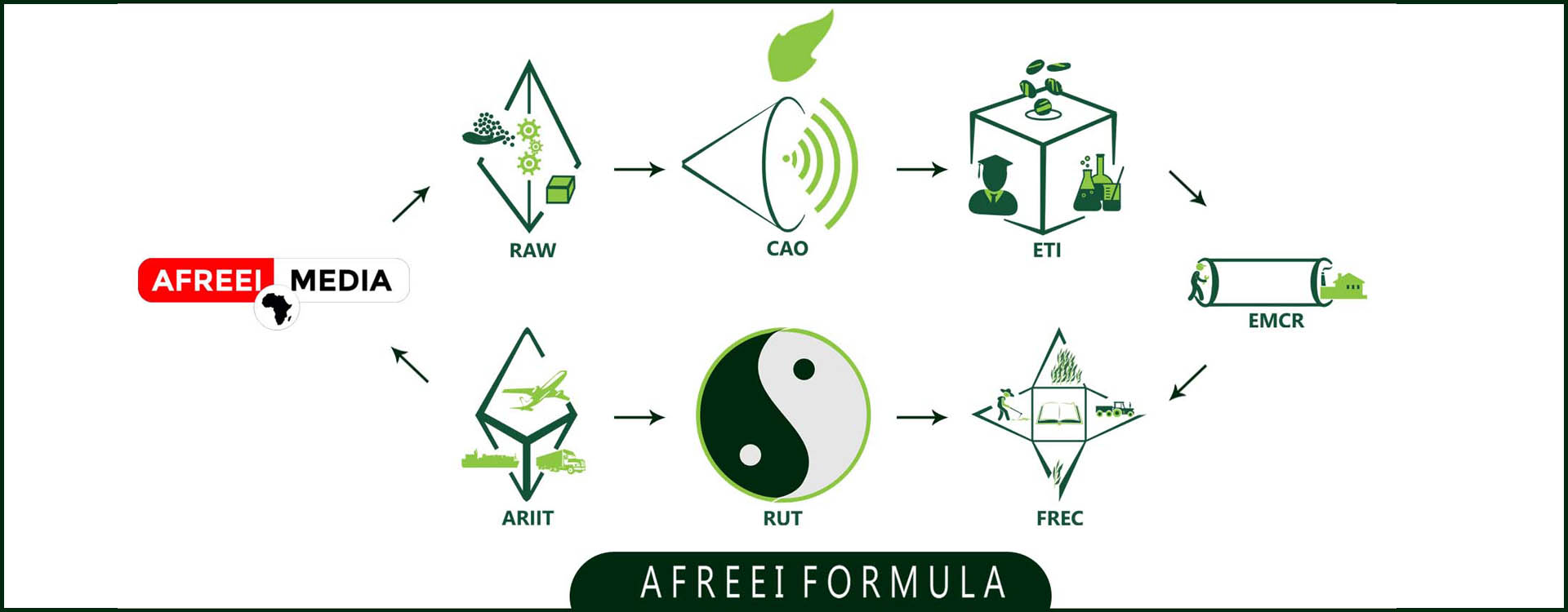
AFREEI8 is designed to support connected economic and social outcomes by bringing resources, research, people, enterprises and markets into a coordinated development system.
Increased productive output across agriculture, manufacturing and services.
Sustainable workspaces generated as successful models develop into enterprises.
Reduced resource waste and stronger connections between rural production and urban food systems.
University research developed towards practical, market-ready enterprise prototypes.
Stronger rural productivity through education, enterprise and productive market relationships.
Regional production connected to domestic, intra-African and international markets.
Structured opportunities for domestic and foreign capital to participate in productive enterprises.
Shared economic purpose that can strengthen cooperation and cohesion across communities.
More of the value created from a region’s resources can contribute to its productive capacity and growth.
AFREEI invites governments, educational institutions, development organizations, investors, private enterprises, traditional institutions, civil society and responsible media leaders to examine, strengthen and participate in this economic engineering system.